


Description
Every family member comes to the holidays with different ideas. Time is finite, budget is finite, and no two wish lists look alike. This game gives everyone — parents and kids — a way to put their wishes on the table and work out priorities together.
What do you need?
Playing cards:
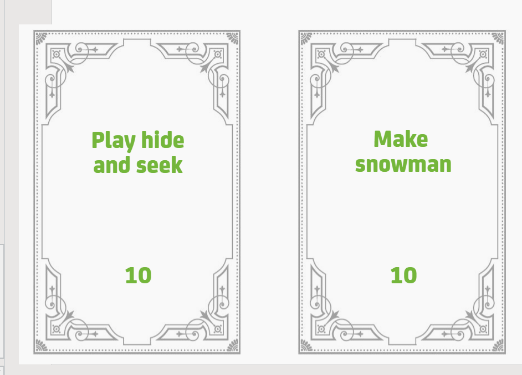
- Take a deck of playing cards and add stickers with activities and their point value — their “price.”
- Plain post-its or scraps of paper work just as well if you want to keep it simple.
Wang Man’s instinct, though, was that playing cards set the right tone — something about holding a hand of cards puts you in the mood for the haggling and bargaining that sits at the heart of this game.
Pens and crayons to write and draw on the cards.
Coins, toy money, tokens. Each has the same face value.
Let’s do it!
Start by giving everyone a moment to think about what they actually want from the holiday.
Then agree on the rules. Our suggestion: each family member gets 5 coins, each worth 10 points — giving a family of four a total budget of 200 points to spend on activities.
Next, everyone gets blank cards and fills them in. Write, draw, or do both — whatever suits the age and the mood. There’s no limit on how many cards you can make. The person who creates a card also sets its price, in one of three sizes: 10 points for small, 20 for medium, 30 for large. Expect some debate here. A child might price a board game at 10 points; if the parents aren’t particularly enthusiastic, the value might need to go up. Sizing a story correctly is an art in any agile project — it takes practice.
Once all the cards are done, lay them out in the middle of the table.
The shortest player buys first. Pick the activity you want most — but here’s the rule: every time you buy something, you have to tell the family why, and what it means to you.
For the expensive ones, negotiate. You can pool your points with other family members — but you’ll need to make a convincing case. Why should they spend their budget on your activity?
The game ends when everyone is happy with what they’ve bought. Leftover points are perfectly fine.
What makes this an agile parenting tool?
By the end of the game, everyone — parents and kids — will have practiced something worth practicing:
- Prioritising in a way that works for the whole group, not just yourself.
- Managing the people around you and what they need.
- Making your case clearly and listening when others make theirs.
These were Wang Man’s takeaways
- The game makes prioritisation tangible — when resources are limited, you quickly find out what you actually want versus what just sounded nice.
- It’s a fast, effective way to work through a long wish list without endless discussion.
- Everyone gets a real say — not just the loudest voice in the room.
- The result is a high-level holiday plan built on what each family member genuinely values.
- And along the way, you’ll learn things about your family that a normal planning conversation would never surface.
Give it a try and let us know how it goes — experiences, surprises, and takeaways all welcome in the comments below.