


Description
My daughter Antonia loves playing Roblox with her best friend, who lives in Australia. Honestly, I think computer games have a place in a healthy childhood — and there’s something that genuinely warms my heart about hearing the two of them strategising over a MS Teams call while they play.
That said, I limit screen time. There’s too much else to explore. The side effect: Antonia accumulates fewer in-game credits, which means no fancy outfits for her avatar, no upgrades to her virtual home, no better digital toys.
The frustration was real. So we sat down and figured it out — starting with Antonia educating me on how “Adopt Me” actually works. Credits, it turns out, can either be earned in the game or purchased with real money via the parents’ credit card.
I’ll be honest: spending real money on tokens in a virtual world, with nothing physical to show for it, strikes me as a complete waste. But then again, I am not a nine-year-old digital native. It’s entirely possible that I’m the one missing the point.
Let’s do it!
The solution we landed on: she could still earn her way to purchasing power in the virtual world — just through the real one first. Complete tasks, earn rewards, spend them on Robux. Antonia’s target was 1.300 Robux, which came to around EUR 15.
I laid out what I needed from her:
- Practice creative writing in German — a subject she actively avoids.
- Experiment with the website toolbox I had installed on her iPad.
- Create content for it. She’d had an idea brewing for a while — an animal lovers’ and activists’ community.
- Help around the house.
Antonia did the maths. If she worked hard, she could hit her Robux target within a week.
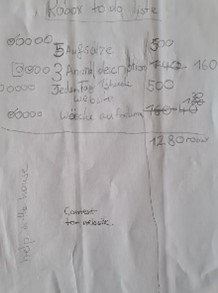
These were her assumptions:
- One piece of creative writing: 100 Robux.
- One hour experimenting with the website toolbox: another 100 Robux.
Now comes the hard part…
The two hardest, most tedious tasks commanded the highest price. Complexity, as seen through the eyes of a nine-year-old.
- Three pieces of content for her website came in at around 50 Robux each. She’d probably spend an hour on each one, research included — but since she actually enjoyed it, it was “cheaper.”
- Helping around the house: 10 Robux per day, for an unspecified amount of work. Low, because she accepted that household chores are duties, not a service she’s rendering.
When I looked at the result, something clicked. Antonia had naturally landed on a logic that closely resembles story points — arrived at through a kind of accidental reverse engineering.
Agile teams use story points to estimate effort. The rule is simple: the people doing the work do the estimating, because they know best what’s easy and what isn’t. Skill level, context, and experience all factor in. Crucially, the unit of measurement is not time — it’s relative effort. There’s no fixed definition, no Excel formula. Story points are deliberately imprecise, built to capture the qualitative texture of a task. Honestly, they’d always struck me as a little esoteric.
Until a nine-year-old reinvented them over a Roblox negotiation.
It’s Not About How Long It Takes. It’s About How Much It Costs You.
It finally clicked. A story written in German, with a fixed structure and zero tolerance for spelling mistakes, is genuinely painful — and should therefore cost more than an inspired piece about endangered animals, lovingly illustrated. Even if both take exactly the same amount of time.
This is why story points confuse people in real IT projects: they don’t predict billable hours or delivery dates, and that feels uncomfortable. Yet Antonia arrived at the same logic without ever hearing the term.
What I suddenly understood is where the power of story points actually lies. They acknowledge the struggle. They recognise that doing something well — really well — costs more for some people than others, in ways that a clock can never capture. That’s not imprecision. That’s fairness.
What makes this an agile parenting tool?
- Story points surface the effort behind the outcome — and in doing so, they signal something deeper: respect for the person doing the work, and genuine appreciation for what it costs them.
- As always, alignment matters. Your idea of “easy” may not match your team member’s — or your child’s. Only the person doing the job knows what it truly takes. That voice deserves to be heard.
- The metrics we default to — time spent, pages written, test scores, certificates — don’t always reflect real learning. Agile parents value the process, not just the result.
What metrics actually reflect progress in your family? Hours not spent on the iPad. Peaceful dinners per week with no finger-pointing. We’d love to hear yours — drop them in the comments below.